Why you can trust TechRadar
We spend hours testing every product or service we review, so you can be sure you’re buying the best. Find out more about how we test.
Asustor AS6702T v2: 30-second review
Asustor is, for those curious, the storage arm of Asus, and for years it has sold NAS that sit between basic home boxes and full business servers. The Lockerstor range is pitched for prosumer and small-business use.
Today, I’m looking at the Lockerstor 2 Gen2+, model AS6702T v2, which refreshes the 2022 Lockerstor 2 Gen2. The biggest change is networking, where two 2.5GbE ports have become two 5GbE ports, but sadly the rest of the hardware carries over, including the Intel Celeron N5105 processor and 4GB of RAM.
That makes this a more specialised NAS than the entry-level models that most home users migrate. It has four M.2 slots alongside its two SATA bays, an HDMI output, two 10Gbps USB ports and an all-metal chassis. The x86 processor also means it can run Docker containers and virtual machines, which ARM-powered rivals can’t match. It is built for people who want speed and flexibility rather than the lowest possible price.
Latest Videos FromTechRadar
The obvious question is why you would pay this much when the Ugreen DXP2800 lists at $346.99 / £349.99 and the DXP2800 GT at $399.99 / £459.99. For many buyers, the honest answer is that you wouldn’t. Both Ugreen models use newer processors, and the GT adds a 10GbE port. The Asustor fights back with build quality, storage flexibility and a longer warranty, and some people will value those aspects more than a better paper specification.
Overall, the AS6702T v2 is a very capable two-bay NAS for fast networks and NVMe pools. As a pure value proposition, it is much harder to defend. It deserves a place in our best NAS device for those specific needs, but not as a bargain.

Asustor AS6702T v2: Price and availability
- How much does it cost? From $517/£486/€616
- When is it out? Available now
- Where can you get it? Online retailers, including Amazon and Newegg
Asustor’s suggested US price for the AS6702T v2 is $569.99, but the street prices are lower, with Amazon, Newegg and B&H all listing it at $516.99 in the US.
In the UK, Amazon.co.uk shows £504. Which, if we do the exchange rate calculation, makes it the equivalent of $673 in the UK, or 30% more expensive for UK customers. In Europe, the Amazon cost is €616.06, which is $693 in US dollars, or even more inflated. Not sure why Asustor dislikes Europeans so much, the way they price their hardware.
But to be frank, irrespective of where you source it, this is a lot for a two-bay NAS with 4GB of RAM and no drives. The Ugreen NASync DXP2800 lists at $349.99 / £349.99, which makes it well over $220 cheaper. The DXP2800 GT lists at £365.99 in the UK and $399.99 in the US, with current promotions.
Synology’s DS225+ is the other obvious rival, priced at only $310.24 on Amazon.com. It has a slower Celeron J4125, 2GB of RAM and no M.2 slots, but its DSM software is the benchmark that Asustor’s ADM is judged against.
What the AS6702T v2 delivers is speed and flexibility rather than savings. If you want four NVMe slots in a two-bay chassis, it is an unusual and relatively affordable option. If you don’t, you are paying for features you won’t use.
At these prices, the AS6702T v2 seems overpriced by at least $100 or more.

Asustor AS6702T v2: Specs
|
Item |
Spec |
|---|---|
|
CPU: |
Intel Celeron N5105 (4 cores, 4 threads, 2.0GHz, 2.9GHz burst) |
|
GPU: |
Intel UHD Graphics (24 EU) |
|
RAM: |
4GB DDR4 SODIMM (two slots, expandable to 16GB) |
|
Internal Storage: |
8GB eMMC for ADM |
|
SATA Storage: |
2 bays (3.5 or 2.5 inch mechanisms), hot swappable |
|
M.2 Storage: |
4 x M.2 2280 NVMe (PCIe 3.0 x1 each) |
|
Ports: |
2 x USB 3.2 Gen 2 Type A (10Gbps) |
|
Networking: |
2 x RJ45 5GbE (also 2.5GbE, 1GbE and 100Mbps) |
|
OS: |
ADM 5.1 |
|
Maximum Capacity: |
2 x 18TB SATA (36TB) |
|
RAID Modes: |
Single/JBOD/RAID 0/RAID 1 on SATA |
|
PSU: |
65W external adapter |
|
Power: |
21W operating, 13.5W disk hibernation (Asustor figures) |
|
Noise: |
17.7dB with drives idle (Asustor figure) |
|
Dimensions: |
H163.5 x W108 x D230 mm |
|
Weight: |
2kg |
|
Warranty: |
3 years |
Asustor AS6702T v2: Design
- Metal chassis
- Screwed trays
- Hidden slots
The AS6702T v2 is a plain, businesslike NAS. There is no flashy trim, just a black metal case with a plastic face that suits Asustor’s more business-oriented Lockerstor range. At 163.5mm tall, 108mm wide and 230mm deep, it is almost exactly the size of Synology’s DS225+, although at 2kg it is noticeably heavier.
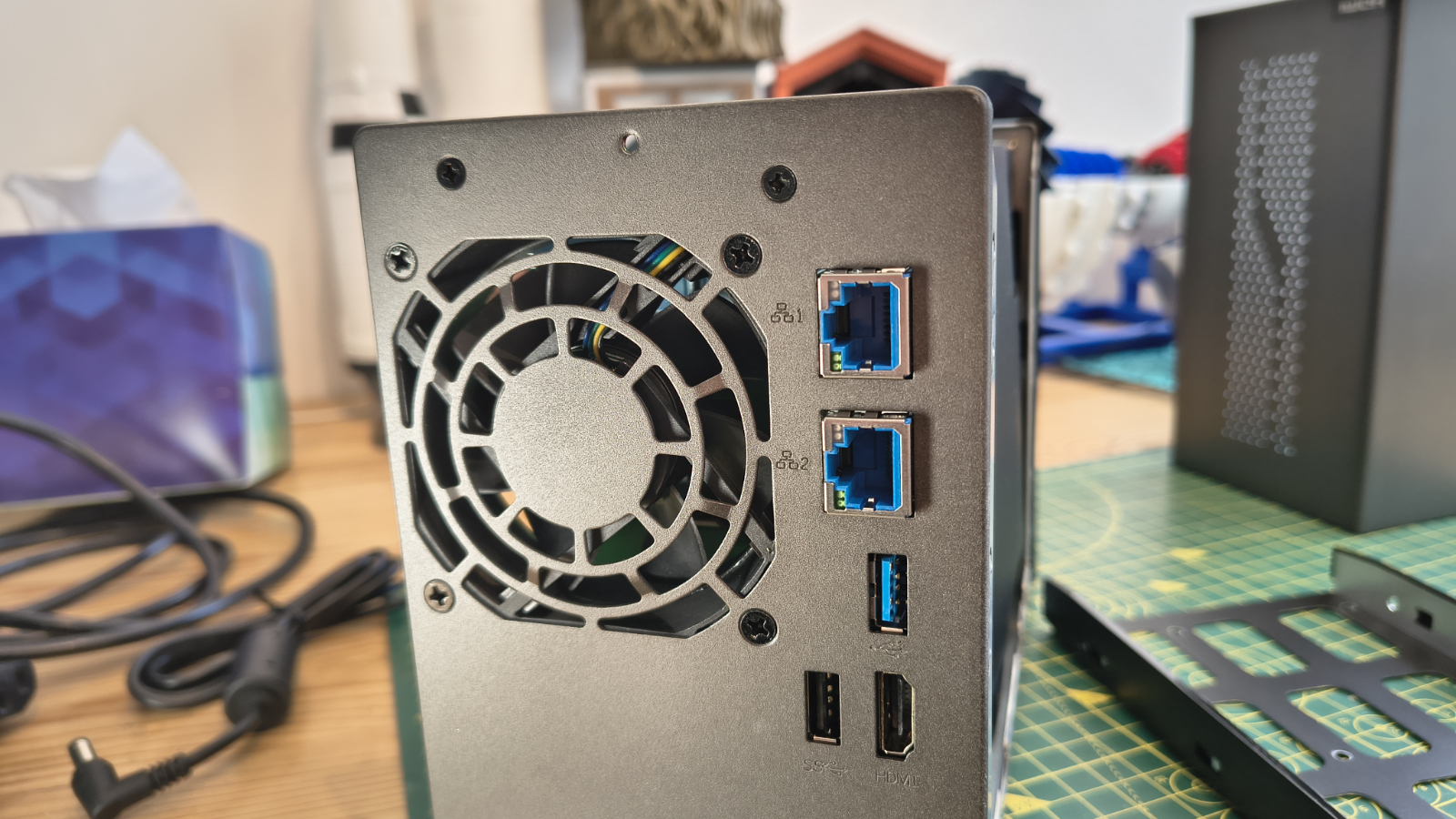
The two drive bays sit at the front and pull out with a latch. Beside them are status lights and a single 10Gbps USB Type A port. At the back are the two 5GbE ports, a second 10Gbps USB port, an HDMI output, a USB 2.0 port and a 70mm fan.
My main ergonomic complaint is how the drives are fitted. Every 3.5-inch drive uses four screws to attach it to its tray, and Asustor supplies two bags of them in the box. Tool-free trays have been normal for years, and even Asustor’s own AS4002T had them almost a decade ago.
Does it come down to cost? Because given the price of this hardware, it shouldn’t.
The only NAS I’ve seen recently which needs screws for mounting drives came from Beelink, since all of the main players transitioned to tool-less trays years ago.

But then, the upgrades are just as fiddly. To reach the four M.2 slots or the RAM, you have to open the case, which means removing more three more screws. Thankfully, the M.2 drives themselves need no tools once you are inside. The empty RAM slot is reasonably easy to reach, but the stock 4GB module sits on the underside of the board and needs far more disassembly to swap.
Almost every other brand, including Synology, has a removable panel or other means for accessing the memory slots without dismantling the whole NAS.
In the box, you get a 65W power adapter, two network cables and the screws. Cooling comes from a single 70mm fan, and Asustor rates the NAS at 17.7dB with the drives idle. Those numbers seem accurate, and this is a quiet NAS that won’t disturb you while you sit at the desk.
What I can’t fault is that Asustor has supreme confidence in its hardware, offering a three-year warranty. That’s a year more than Ugreen, and the same as Synology.
Asustor AS6702T v2: Features
- Celeron N5105
- Four M.2 slots
- Dual 5GbE
The AS6702T v2 uses the same Intel Celeron N5105 as the 2022 model. This quad-core chip has four threads, runs at 2.0GHz, and turbo boosts to 2.9GHz. It includes UHD Graphics, which handles hardware video decoding and transcoding for media apps.
That was a sensible choice in 2022, when Asustor launched its predecessor. Today it looks tired. Intel’s N100, which powers the Ugreen DXP2800, arrived in 2023 with better efficiency and a higher peak clock of 3.4GHz.
The DXP2800 GT goes further with an AMD Ryzen Embedded R2514, which has four cores, eight threads and a peak of 3.7GHz. The N5105 remains perfectly capable of file serving, backups, Plex, and light containers, but it can no longer be considered a power platform unless you compare it to ARM-based NAS.
Memory is the other soft spot. The AS6702T v2 ships with a single 4GB DDR4 SODIMM and a second empty slot, allowing 16GB total from two 8GB modules. That’s the maximum this platform can support, because Intel didn’t consider that anyone would want a Celeron N5105 system with more than 16GB of memory on it.
The only positive aspect of this arrangement is that the memory will work in single-channel mode, enabling it to still function if you mix memory sizes. That allows you to put an 8GB module alongside the 4GB option and get 12GB. That is a useful upgrade, and more than the 6GB that the Synology’s DS225+ gets. But it’s dramatically less than some competitor devices which come with 8GB and can be upgraded to 64GB.
The four M.2 slots are the most unusual feature, and frankly it’s slightly misleading for those thinking that they’re getting more SSD throughput than some NAS with dual slots.
They accept 2280 NVMe drives and can be used as a cache, as a storage pool, or even as the main volume for ADM and its apps. M.2 volumes also support RAID 5, 6 and 10, which the two SATA bays cannot offer, since it only has two drives.
The catch? Each slot runs at PCIe 3.0 x1, so a single drive tops out at around 1GB/s, no matter how fast the drive is rated. That still beats any hard drive several times over and is enough to feed a 5GbE link.

But again, one of its competitors, the original Ugreen DXP2800, has two slots: one PCIe 4.0 x4 and one PCIe 3.0 x2. Therefore, its combined throughput on the two slots is 10GB/s, whereas the AS6702T v2 tops out at 4GB/s from the SSDs.
In both cases, unless you’re processing heavily on the NAS, the best use for the SSD slots is to cache the hard drives, but I’d recommend running any system with that arrangement on an uninterruptible power supply to avoid a power outage corrupting the data volumes.
Networking is where Asustor earns its premium badge. Both RJ45 ports run at 5GbE and fall back to 2.5GbE, 1GbE or 100Mbps, so they work with any switch. They support link aggregation, and with SMB Multichannel, Asustor claims up to 10Gbps of bandwidth.
However, the HDD storage in this unit can’t reach those levels, and two drives will struggle to saturate one 5Gbps LAN port even in RAID 0 mode. Without an SSD cache, you can’t make the most of the 5GbE LAN ports.
There is no 10GbE upgrade path, though, because the two-bay model doesn’t take the optional card that the larger Gen2+ models can use. In theory, you could run an M.2 to 10GbE LAN adapter if you are careful, but I’m not sure what advantages that might unlock.

Two 10Gbps USB ports support up to two four-bay AS5004U expansion units, bringing the total to ten drives. Each expansion unit works as a separate storage pool with its own RAID rather than adding to the main volume.
With these expansion options attached, the 5Gbe LAN ports do make more sense, but again SSD caching will be required to make it fully worthwhile. The issue is that if you want to have a 10-bay NAS, there are cheaper and more effective ways than buying a 2-bay NAS and adding two $320 expansion boxes to it.
A positive aspect is that power use is minimal. Asustor quotes 21W in operation and 13.5W with the disks hibernating. I estimate that the running overhead for this NAS with two hard drives and four SSDs would be about 400Wh over 24 hours, which is greater than the 275Wh you might use for a Synology DS225+. But then, this is a more powerful NAS.
Asustor’s specification page lists 36TB as the maximum, which is two 18TB drives, but that looks like the largest size tested rather than a hard limit. I’d be surprised if 40TB drives, or larger, wouldn’t work with this hardware when they become widely available.
The result is a platform that is strong on networking and storage flexibility, but short on processor and memory headroom. The choice of the Celeron N5105 was critical, as was the choice not to upgrade it in the V2 generation. This CPU can only address 16GB of RAM, has few PCIe Express lanes and can only use DDR4 memory. And in 2026, that looks a bit light on expectations.
Asustor AS6702T v2: Software
- ADM 5.1
- No flexible RAID
- TrueNAS and UNRAID possible

The AS6702T v2 runs ADM 5.1 (5.1.4.RM62), which Asustor originally released in late 2025. It is the first version to support post-quantum cryptography, adding hybrid TLS encryption designed to resist attacks from future quantum computers.
Setup is straightforward. You find the NAS with Asustor’s Control Center app, or by browsing to its address on port 8000, and ADM then downloads and installs in about ten minutes.
I’ve seen some reviewers declare that they had a system full of drives up and running in half an hour, but I doubt that. In my instance, it took nearly four hours to deliver an initialised machine with two 2TB hard drives in RAID 1 (Mirror) configuration and a single 1TB SSD configured for a read cache. Larger drives will take longer, so don’t assume you will be up and running the same day the hardware arrives.
ADM looks and behaves like a simple Linux desktop, and it has a good search tool for finding settings. There are around 150 official apps in App Central, including Plex Server, Download Center, EZ Sync and the LooksGood media player. Docker, VirtualBox, Btrfs snapshots and cloud backup are all included, and most are well designed.
Depth is the weakness. Surveillance Center is simple and well behind Synology’s equivalent, VirtualBox is awkward to use, and the Snapshot Center works on whole volumes rather than individual shared folders. None of the backup or sync apps offers file versioning either, which makes it harder to recover from accidental changes.
Overall, ADM 5.1 is competent but hardly revolutionary.

The file system offers Ext4 or Btrfs, and on the latter you can have WORM (Write Once, Read Many) volumes to provide immutable, tamper-proof, and ransomware-resistant data storage in shared folders.
However, there is also no equivalent of Synology Hybrid RAID. ADM supports only standard RAID options, so mixing drives of different sizes simply wastes space. This feature is also available on TerraMaster hardware, and the UNRAID platform. According to my research, it is possible to run UNRAID, TrueNAS or OpenMediaVault on this hardware and dispense with ADM, but that would probably negate your warranty to some degree or another.
Conversely, TerraMaster and, on occasion, Synology have included HDMI ports on their NAS with no means for the users to access this feature for outputting media. On ADM there is a mechanism for doing that via the Portal app, which curiously uses Firefox to create the web interface. This approach seems somewhat flaky, and it would probably be better to use JellyFin on the machine and stream it to a TV using a Firestick or Google TV dongle.
For home users and small offices, ADM is a solid foundation. It just isn’t the reason to buy this NAS.


Asustor AS6702T v2: Performance
- 5GbE speed
- Hard drive limits
- NVMe pools
Two 5GbE LAN ports promise speed, but storage determines what you will actually see. Typical drives manage about 150MB/s each depending on spec and size, so RAID 0 tops out near 300MB/s. RAID 1 should write at the speed of one drive and read marginally faster.
Configured in RAID 1 with two WD Red Plus 2TB drives and a single SSD as cache, I measured about 230MB/s reads and 181MB/s writes, limited by my 2.5GbE test network.
Without the read SSD cache, the numbers changed to 234MB/s reads and 183MB/s writes, which probably indicates RAM is being used for caching.
Switching to RAID 0 (Striped) delivered 232MB/s reads and 236MB/s writes without an SSD cache, but obviously if either drive fails, the data on it will be lost. And finally, I configured the single SSD to be a shared folder, and curiously that transfer didn’t go any faster than the RAID 0 volume. It should have saturated my 2.5GbE network, so that it didn’t was odd.
Since I’d made so many changes without a restart, I rebooted the NAS, and after that it managed sustained read and write at 280MB/s, the full capability of a 2.5GbE network.
That is why the 5GbE ports make little difference with hard drives alone. It’s also worth saying that while network switches with 2.5GbE and 10GbE LAN ports are relatively easy to find, ones with specifically 5GbE aren’t that common.
Asustor’s own figures show what 5GbE can do when the storage keeps up. Using SSDs, it quotes about 591MB/s in each direction over a single link, and around 1,050MB/s with both ports aggregated through SMB Multichannel. Those are lab results from optimised hardware, so expect less in a typical home or office.
The caveat is that getting that magical 1000MB/s+ level of performance assumes you have either dual 5GbE LAN ports on the host system or 10GbE; if it’s the latter, you might want to consider a NAS with a 10GbE port and dispense with SMB Multichannel.
Asustor AS6702T v2: Final verdict
The AS6702T v2 is a capable, well-made NAS that solves network speed issues in a two-bay chassis. The dual 5GbE ports and four M.2 slots give it options that most rivals can’t match, and the metal build and three-year warranty inspire confidence.
However, it looks like it was designed for a future where NVMe SSDs were cheap, and that’s not the multiverse we ended up in.
And, even if you have a drawer of unused SSDs, what holds it back is everything around those headline features. The Celeron N5105 is ageing, 4GB of RAM is stingy, the screwed trays and hidden slots are irritating, and ADM lacks the depth of Synology’s NAS operating system. And don’t get me started on Asustor’s naming convention, which seems to be taking its cues from German Komposita. What’s wrong with “AS6702T 2026 Edition”?
And then there is the price, which seems to assume that Asustor NAS are built to a higher quality than other brands. Where the reality is that Ugreen and Synology are equally well-made, and TerraMaster isn’t far behind.
The US cost of $516.99 is even harder to accept when the newer DXP2800 GT costs only $399.99 on Amazon.com and comes with 8GB of RAM and a 10GbE LAN port.
If you have a multigigabit network and want an NVMe pool alongside a pair of hard drives, it might be an excellent choice. Everyone else should look at the Ugreen alternatives first, or wait for a seasonal discount.
Should you buy a Asustor AS6702T v2?
|
Value |
Seems pricey considering it uses an old CPU |
3.5 / 5 |
|
Design |
Straightforward, but still using screwed trays |
3.5 / 5 |
|
Features |
x86-based, but M.2 slots are only Gen3 x1 |
3.5 / 5 |
|
Software |
WORM volumes and lots of apps, but no Hybrid RAID |
4 / 5 |
|
Performance |
Two drives limits throughput without SSDs |
3.5 / 5 |
|
Overall |
A great 2022 NAS, but its 2026 |
3.5 / 5 |
Buy it if…
Don’t buy it if…
For more NAS solutions we’ve collated the best NAS hard drives around